
Fitting position


Mounting, control/trailing arm
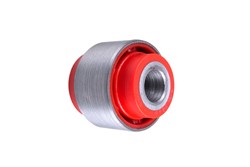
MPBS
Polyurethane front Swingarm bushing (1 pcs) 5102448-00/80SHA RENAULT LAGUNA, LAGUNA III
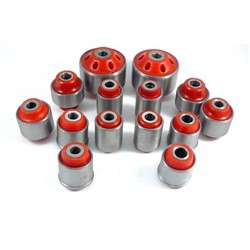
MPBS
Rear suspension set - MPBS 4503503 (14 pcs) 4503503/80SHA/47


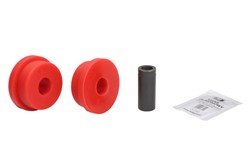
TEDGUM
Polyurethane suspension sleeve (1 pcs) In the back/In the front/Rear 00417961 MERCEDES G (W460), G (W461), G (W463)
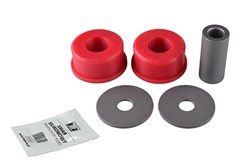
TEDGUM
Track control arm silent block In the back/In the front/Rear 00507662 OPEL FRONTERA B
TEDGUM
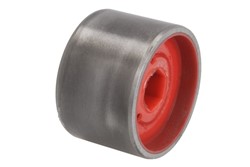
Polyurethane bushing (1 pcs) 00727181 AUDI A2, A3; LEXUS RX; SEAT ALTEA, ALTEA XL, CORDOBA, IBIZA III, LEON, TOLEDO III; SKODA FABIA I, FABIA I PRAKTIK, FABIA II, OCTAVIA II, ROOMSTER
TEDGUM
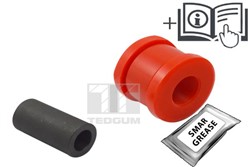
Polyurethane bushing (1 pcs) In the back/In the front/Rear TED58180 TOYOTA LAND CRUISER 80

TEDGUM
Mounting, control/trailing arm TED76683
TEDGUM
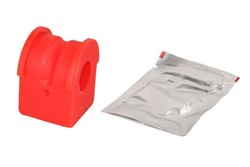
Polyurethane stabilizer bushing (1 pcs) Front/Inside 00587046 RENAULT ESPACE IV
TEDGUM
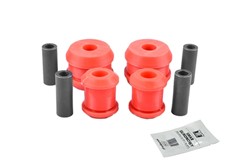
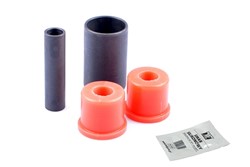
Polyurethane suspension bushings set (4 pcs) Front TED35971 HONDA CIVIC VII, CR-V II, ELEMENT, FR-V, INTEGRA
TEDGUM
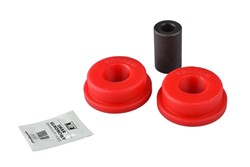
Polyurethane bushing (1 pcs) Front/Outside TED51064 DODGE NITRO; JEEP CHEROKEE, LIBERTY
TEDGUM
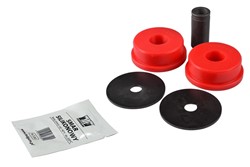
Polyurethane stabilizer bushing (1 pcs) Front TED83109 BMW 3 (E30), 3 (E36), Z1, Z3 (E36)
TEDGUM
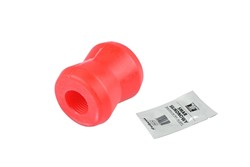
Polyurethane bushing (1 pcs) In the back/Rear 00447354 MITSUBISHI PAJERO I, PAJERO II
TEDGUM
Polyurethane shock absorber bushing (1 pcs) Rear 00657341 SUZUKI SAMURAI, SJ410, SJ413
TEDGUM
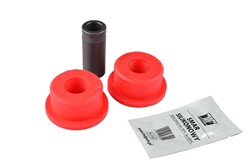
Polyurethane bushing (1 pcs) In the back/Rear TED12518 SUBARU FORESTER, IMPREZA, LEGACY I, LEGACY II, LEGACY III, LEGACY OUTBACK
TEDGUM
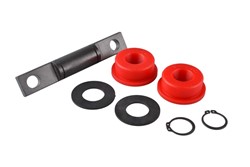
Polyurethane rear upper transverse swingarm bushing (1 pcs) Rear TED42520 HONDA CIVIC VII
AKUSAN
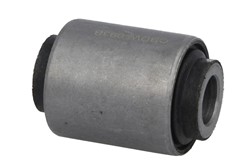
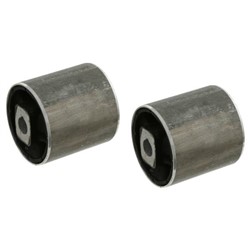
Mounting, control/trailing arm TP 0002
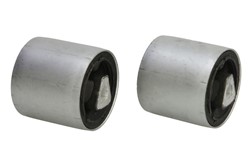
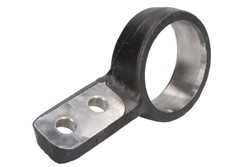
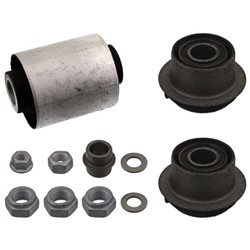
FEBI
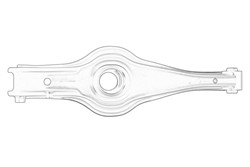
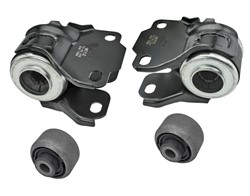
Mounting, control/trailing arm FE09005



Control Arm Bushings – Essential Suspension Components
The car's suspension system comprises several interconnected components working in harmony. Its primary purpose is to ensure proper wheel adhesion to the road surface (both on straights and curves) and provide ride comfort.
One of the key suspension parts is the bushing, a rubber-metal component used to attach the control arm to the chassis. The bushing acts as the pivot point for the control arm and, through its rubber layer, absorbs vibrations. This prevents vibrations from transferring to the car body, reducing noise levels. Hence, this part is often referred to as a silentblock (silent meaning quiet).
Bushings are among the fastest-wearing suspension components. Despite advancements in synthetic materials, they eventually deteriorate due to stress and material ageing. High forces and ageing cause the rubber to crack and tear, leading to play in the suspension. This can result in unstable driving (the car pulling to one side or improper handling on curves), delayed or unresponsive wheel reactions, and unusual suspension noises.
To restore the suspension system, a damaged control arm silentblock must be removed using a special press and replaced with a new one. Some vehicles have bushings designed for easier removal, requiring only part of the control arm to be unbolted, making the replacement process quicker.
Find the Perfect Silentblock for Your Vehicle
Control arm bushings come in various designs, differing in shape, mounting methods, and component configurations.
Typically, a front control arm bushing or rear bushing comprises three elements:
- An inner sleeve,
- A rubber connector,
- An outer sleeve.
Both the front and rear bushings are usually made of steel. The inner sleeve has a hole diameter matching the control arm's mounting bolt, while the outer sleeve fits inside the control arm housing.
In some designs, bushings lack an outer sleeve. This setup is used in suspensions where the control arm itself serves this function. Such silentblocks often feature retaining rings to secure them within the control arm.
A front control arm bushing is a variant of silentblock, often equipped with a metal connector welded to its exterior, allowing it to be bolted to the control arm. This design is common in many European, Japanese, and Korean vehicles.
No matter the technical design used in your car, you can find control arm bushings for your vehicle in the Inter Cars store. Among thousands of options, you will find silentblocks for front and rear suspensions suitable for European, American, Japanese, and Korean cars. Reputable brands include TRW, Moog, Magneti Marelli, Meyle, Febi, Sasic, Reinhoch, Korea Tedgum, and Delphi.
Well-Maintained Control Arm Bushings – Safety and Stability
The suspension system is a critical component of a vehicle that directly impacts driving safety. Wear and tear in this system can make the car unstable. Wheels may fail to follow the road surface properly, and during manoeuvres, they might operate at incorrect angles. Under high forces, this can lead to loss of control or accidents.
A car with worn bushings becomes difficult to drive on uneven surfaces, with excessive vibrations transmitted to the steering wheel. This not only makes driving uncomfortable and tiring but also poses safety risks.
Replacing control arm bushings is not costly. A quality silentblock from a reputable brand typically costs a few dozen pounds. Including the mechanic’s labour, the total cost for one axle is about £50–£100. Considering the potential dangers of worn bushings and the fact that new ones usually last 5–10 years, it’s worth addressing the issue promptly.
FAQ Section
What happens if a control arm bushing fails?
A heavily worn control arm bushing poses significant safety risks. Drivers may notice increased jolting and instability, even on minor road imperfections. Worn bushings lead to delayed steering responses, which can result in accidents. Prolonged use of a car with faulty bushings can also accelerate tyre wear.
How much does it cost to replace a control arm bushing?
Replacing a control arm bushing is an affordable service. The cost of a single bushing ranges from £5 to £10 for budget options, with premium brands costing slightly more. Mechanic fees for the replacement typically range between £50 and £100, making the total cost manageable for most budgets.
What is a silentblock?
A silentblock, also known as a metal-rubber bushing, is a flexible connector used in the suspension system. It consists of an inner and outer sleeve, with synthetic rubber as the flexible element. Its primary function is to dampen vibrations during driving. Silentblocks wear out over time and should be replaced periodically to maintain optimal performance.